Hedging is how smart bettors turn a live ticket into a guaranteed profit, or protect a stake that is suddenly at risk. Instead of sweating one final result, you place a calculated bet on the other side and walk away ahead no matter what happens. This guide explains how hedging works, walks through a worked example, compares it to a sportsbook cash-out, and links you to a free calculator and printable worksheet.
What Hedging a Bet Means
To hedge a bet is to wager on the opposite outcome of a bet you already hold. The goal is not to win big on one side but to guarantee a result you like across both. Hedging shines when a bet has gained value: a futures ticket that is now one game from cashing, or a parlay sitting on its last leg. Rather than risk the whole payout on a coin flip, you lock in profit.
The Hedge Formula
Start with your original bet’s potential return, which is your stake times its decimal odds. To make both outcomes pay the same, divide that return by the decimal odds available on the other side. The result is your hedge stake. Bet it, and whichever side wins you collect the same amount, so your profit is simply that return minus everything you staked.
A Worked Example
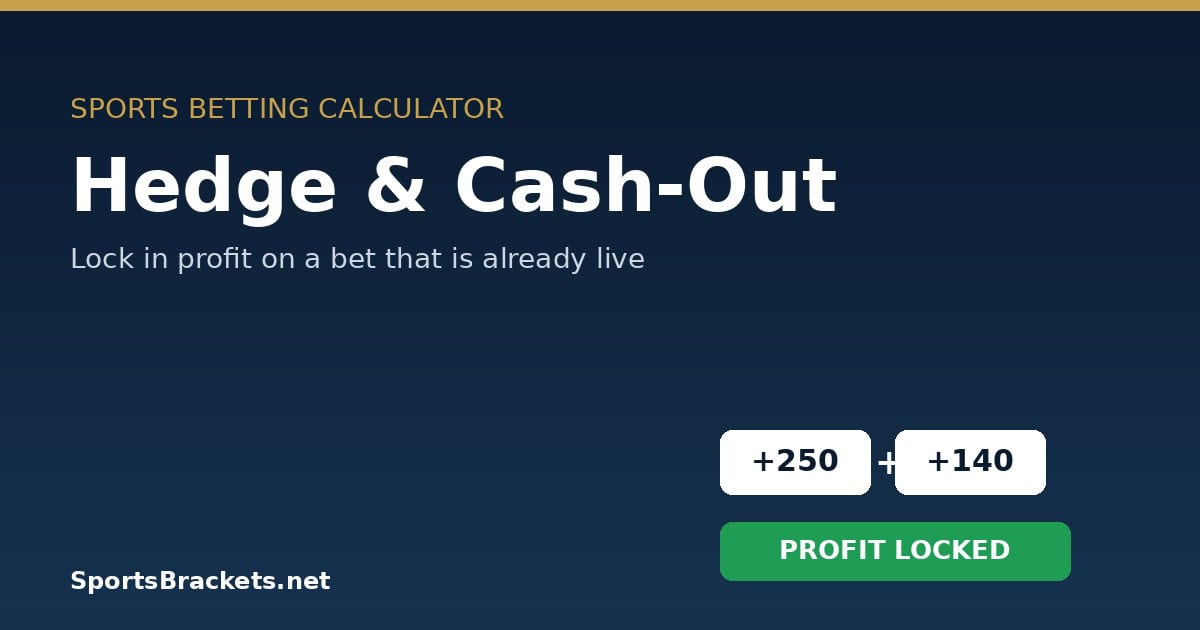
Suppose you bet $100 on a team at +250, decimal 3.50, so the ticket returns $350 if it wins. The opposing outcome is now priced at +140, decimal 2.40. Divide $350 by 2.40 and you get a hedge of about $145.83. Your total staked is $245.83, both results return $350, and you lock in roughly $104.17 of guaranteed profit, about a 42 percent return. Skip the hedge and you either win $250 or lose your $100.
Try It: Hedge Betting Calculator
You do not need to run the arithmetic by hand. Our free hedge betting calculator takes your original bet and the current odds on the other side and instantly returns the hedge stake, the guaranteed profit either way, and your ROI. Enter American or decimal odds and see the numbers update as the line moves.
Hedging vs Cashing Out
A sportsbook cash-out is really the book hedging on your behalf and keeping a slice for itself. That is why a manual hedge often locks in more money than the cash-out button offers. The move is to calculate your own hedge first, then compare it to the cash-out figure. Take whichever pays more. The only catch is that a manual hedge needs a second book or market offering fair odds on the other side.
When Hedging Does Not Pay
Hedging only guarantees a profit when the other side’s odds are still generous enough. If the line has moved hard against your original bet, hedging locks in a smaller loss rather than a gain. That is not always wrong, since guaranteeing a small loss can beat risking a total one, but you should know which situation you are in. The calculator flags it before you commit any money.
Free Printable Hedge Worksheet
Prefer to plan at the book? Download the free printable hedge and cash-out worksheet to log your original bet, the current odds, and the hedge stake, then compute your guaranteed profit step by step.
Download the Hedge Worksheet (PDF)
The Bottom Line
Hedging trades a shot at the full payout for a sure thing, and when a bet has gained value that trade is often worth it. Run your numbers through the calculator, compare the result to any cash-out offer, and lock in the better one. As always, bet responsibly and within your means.