Staring at the bar doing plate math in your head? This guide shows you how to load a barbell for any target weight, with the simple arithmetic and a loading chart, or you can use our free barbell load calculator to get the plates instantly.
How to Load a Barbell: Quick Facts
- Step 1: subtract the bar weight (usually 45 lb or 20 kg).
- Step 2: divide what is left by 2 for one side.
- Step 3: load biggest plates first, then work down.
- Always load matching plates on both sides.
- Shortcut: the calculator gives you the plates.
Step 1: Subtract the Bar
Start with your target weight and subtract the weight of the bar. A standard Olympic bar is 45 lb (about 20 kg), a women’s Olympic bar is 15 kg, and many training bars are lighter, so use the right number for your bar.
Step 2: Split It in Half
Whatever is left after removing the bar gets split evenly between the two sides. Divide the remaining weight by two to find how much goes on each end.
Step 3: Load Biggest Plates First
Work down from your largest plates to the smallest to use the fewest plates. Load the same plates on both sides so the bar stays balanced.
Worked Example and Chart
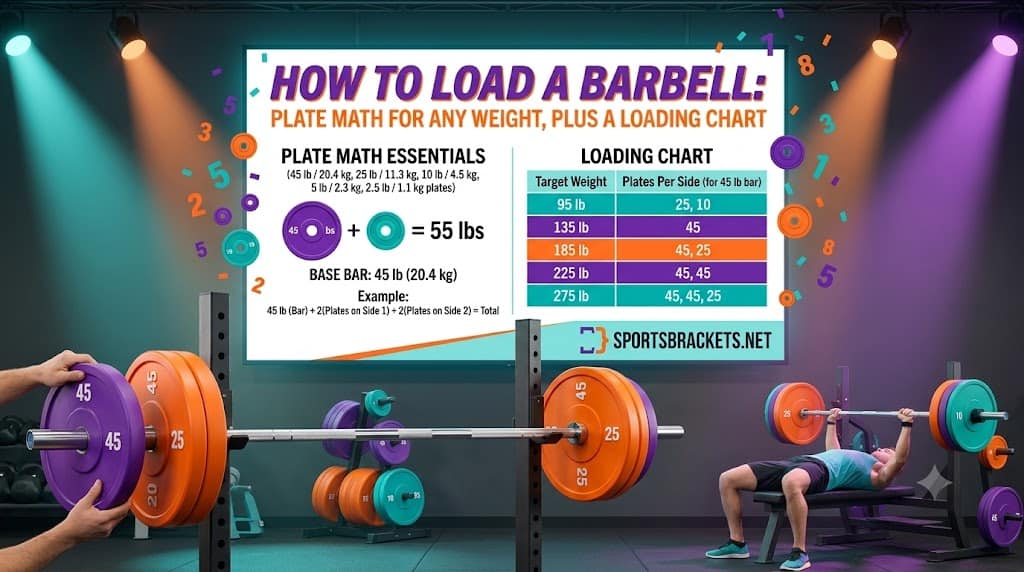
For a 225 lb bench with a 45 lb bar: 225 – 45 = 180, split in half is 90 lb per side, which is one 45 and one 45, or a 45 plus a 25 plus a 10 plus a 10. Common loads per side: 135 lb total is one 45 per side; 185 lb is a 45 and a 25 per side; 225 lb is two 45s per side; 315 lb is three 45s per side.
Frequently Asked Questions
What is the fastest way to do barbell math?
Subtract the bar, halve the rest, and remember that a 45 lb plate on each side adds 90 lb to the bar. Most lifters memorize the big round numbers and use a calculator for the rest.
How much does an Olympic barbell weigh?
A men’s Olympic barbell is 45 pounds (20 kg) and a women’s Olympic barbell is 15 kg. Always confirm your bar before loading.
Why load plates in pairs?
A barbell has to be balanced to lift safely, so every plate on one side needs a matching plate on the other side.
Related Tools