The 2026 FIFA World Cup will be the largest in the tournament’s history, with 48 teams playing 104 matches across 16 host cities in the United States, Canada, and Mexico. One of the biggest behind-the-scenes challenges is the playing surface itself. FIFA requires a specific pitch size, and many of the American stadiums hosting matches were built for football (NFL) or are used by MLS teams, so their fields need significant modification. This article breaks down the official FIFA 2026 World Cup pitch dimensions, explains why these dimensions matter, and details how each host stadium is adapting for the tournament. You can also download a free printable one-page diagram of the regulation World Cup pitch using the button below.
The Official FIFA Standard – 2026 World Cup Pitch Dimensions
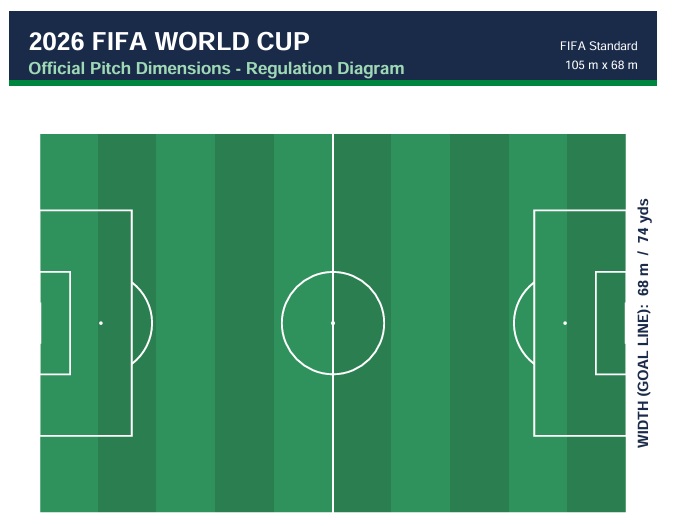
FIFA mandates a standard pitch size for the World Cup. The ideal playing surface is 105 meters long and 68 meters wide, which is roughly 115 yards by 74 yards, as set out in the IFAB Laws of the Game (Law 1: The Field of Play).
The Laws of the Game allow some variation, with length between 100 and 110 meters and width between 64 and 75 meters, but FIFA aims for the 105 by 68 meter standard at every World Cup match to keep play consistent and fair across venues.
Many NFL stadiums are not naturally wide enough for the 68 meter width. A standard American football field is about 48.8 meters, or 53.3 yards, across. Stadiums therefore have to widen the field of play, often by removing seats, building out over existing seating, or modifying field-level structures.
Natural Grass Requirement
A critical FIFA requirement is that all matches must be played on natural grass. Several host stadiums, particularly those used by NFL teams, normally have artificial turf. These venues are temporarily installing natural grass for the tournament, either by growing turf off-site and transplanting it or by installing specialized modular grass systems.
This is a significant undertaking, especially for indoor, domed, or retractable-roof stadiums, which need grow lights and added ventilation to keep natural grass healthy.
Host Stadiums and Their Dimensions
Below is a breakdown of the 16 host stadiums for the 2026 World Cup, ordered by World Cup seating capacity. Each is listed with its host city, its commercial name alongside the official FIFA tournament name, the seating capacity in its World Cup configuration, the playing surface plan, and the target pitch dimensions.
| Host City | Stadium (FIFA Tournament Name) | 2026 WC Capacity | Playing Surface | Target Pitch |
|---|---|---|---|---|
| Arlington, TX, USA | AT&T Stadium (Dallas Stadium) | ~90,000 | Artificial turf converting to natural grass | 105 x 68 m |
| Mexico City, MEX | Estadio Azteca (Estadio Banorte) | 87,523 | Natural grass | 105 x 68 m |
| East Rutherford, NJ, USA | MetLife Stadium (New York New Jersey Stadium) | 82,500 | Artificial turf converting to natural grass | 105 x 68 m |
| Kansas City, MO, USA | Arrowhead Stadium (Kansas City Stadium) | 76,416 | Natural grass | 105 x 68 m |
| Houston, TX, USA | NRG Stadium (Houston Stadium) | 72,220 | Artificial turf converting to natural grass | 105 x 68 m |
| Atlanta, GA, USA | Mercedes-Benz Stadium (Atlanta Stadium) | 71,000 | Artificial turf converting to natural grass | 105 x 68 m |
| Inglewood, CA, USA | SoFi Stadium (Los Angeles Stadium) | 70,240 | Artificial turf converting to natural grass | 105 x 68 m |
| Philadelphia, PA, USA | Lincoln Financial Field (Philadelphia Stadium) | 69,596 | Natural grass | 105 x 68 m |
| Seattle, WA, USA | Lumen Field (Seattle Stadium) | 69,000 | Artificial turf converting to natural grass | 105 x 68 m |
| Santa Clara, CA, USA | Levi’s Stadium (San Francisco Bay Area Stadium) | 68,500 | Natural grass | 105 x 68 m |
| Foxborough, MA, USA | Gillette Stadium (Boston Stadium) | 65,878 | Artificial turf converting to natural grass | 105 x 68 m |
| Miami Gardens, FL, USA | Hard Rock Stadium (Miami Stadium) | 65,326 | Natural grass | 105 x 68 m |
| Vancouver, BC, CAN | BC Place (Vancouver Stadium) | 54,500 | Artificial turf converting to natural grass | 105 x 68 m |
| Monterrey, MEX | Estadio BBVA (Estadio Monterrey) | 53,500 | Natural grass | 105 x 68 m |
| Guadalajara, MEX | Estadio Akron (Estadio Guadalajara) | 49,850 | Natural grass | 105 x 68 m |
| Toronto, ON, CAN | BMO Field (Toronto Stadium) | 45,500 | Artificial turf converting to natural grass | 105 x 68 m |
Why the Width Matters
The width is the hardest target for retrofitted NFL stadiums. A wider pitch gives wingers and full-backs more room to stretch defenses, while a narrower surface compresses play and favors compact, central tactics. Because FIFA wants every match played on as close to 105 by 68 meters as possible, the field-widening work at converted stadiums is about competitive fairness as much as it is about meeting a rulebook minimum.
Conclusion
The 2026 World Cup represents a large logistical effort to bring stadiums up to FIFA standards. From widening fields in NFL stadiums to installing natural grass in domed venues, the host cities are making significant investments to ensure the world’s best players have a world-class surface to play on.
By the time the tournament kicks off on June 11, 2026, all 16 venues will meet FIFA’s standards, providing a consistent, high-quality playing experience for players and fans alike.
Popular 2026 World Cup Resources
Planning your tournament viewing? These free SportsBrackets guides cover the squads, schedules, and brackets you will want on hand.
- 2026 World Cup Roster Directory: All 48 Team Squads
- 2026 World Cup Printable Match Schedules by Host City
- Printable 2026 World Cup Bracket (Round of 32 to Final)
- 2026 World Cup Bracket With Groups Filled In
- Build Your Own Bracket With the Custom Bracket Maker
Frequently Asked Questions (2026 World Cup Pitch Dimensions)
What are the official 2026 World Cup pitch dimensions?
FIFA targets a standard pitch of 105 meters long by 68 meters wide, which is about 115 yards by 74 yards, for every 2026 World Cup match. The Laws of the Game allow some variation, with length between 100 and 110 meters and width between 64 and 75 meters, but FIFA aims for the 105 by 68 meter standard at all 16 venues.
Why do NFL stadiums need to be modified for the World Cup?
A standard NFL field is about 48.8 meters wide, which is narrower than the 68 meters FIFA wants. Stadiums built for American football have seating and structures close to the field, so venues such as AT&T Stadium and Mercedes-Benz Stadium remove lower-bowl seats or use field-level modifications to widen the playing area.
Will all 2026 World Cup matches be played on natural grass?
Yes. FIFA requires natural grass for every match. Several host venues normally use artificial turf and are installing temporary natural grass for the tournament, including indoor and retractable-roof stadiums that need grow lights and added ventilation to keep the grass healthy.
Which 2026 World Cup stadium has the largest capacity?
AT&T Stadium in Arlington, Texas is set to be the largest host venue in its World Cup configuration, followed by Estadio Azteca in Mexico City and MetLife Stadium in New Jersey, which hosts the final.
{“@context”:”https://schema.org”,”@type”:”FAQPage”,”mainEntity”:[{“@type”:”Question”,”name”:”What are the official 2026 World Cup pitch dimensions?”,”acceptedAnswer”:{“@type”:”Answer”,”text”:”FIFA targets a standard pitch of 105 meters long by 68 meters wide, which is about 115 yards by 74 yards, for every 2026 World Cup match. The Laws of the Game allow some variation, with length between 100 and 110 meters and width between 64 and 75 meters, but FIFA aims for the 105 by 68 meter standard at all 16 venues.”}},{“@type”:”Question”,”name”:”Why do NFL stadiums need to be modified for the World Cup?”,”acceptedAnswer”:{“@type”:”Answer”,”text”:”A standard NFL field is about 48.8 meters wide, which is narrower than the 68 meters FIFA wants. Stadiums built for American football have seating and structures close to the field, so venues such as AT&T Stadium and Mercedes-Benz Stadium remove lower-bowl seats or use field-level modifications to widen the playing area.”}},{“@type”:”Question”,”name”:”Will all 2026 World Cup matches be played on natural grass?”,”acceptedAnswer”:{“@type”:”Answer”,”text”:”Yes. FIFA requires natural grass for every match. Several host venues normally use artificial turf and are installing temporary natural grass for the tournament, including indoor and retractable-roof stadiums that need grow lights and added ventilation to keep the grass healthy.”}},{“@type”:”Question”,”name”:”Which 2026 World Cup stadium has the largest capacity?”,”acceptedAnswer”:{“@type”:”Answer”,”text”:”AT&T Stadium in Arlington, Texas is set to be the largest host venue in its World Cup configuration, followed by Estadio Azteca in Mexico City and MetLife Stadium in New Jersey, which hosts the final.”}}]}